Andrew Heffernan, CSCS
Certified in the Feldenkrais Method (2013), Andrew trained under Elizabeth Beringer, one of Moshe Feldenkrais’s original students.
For over a decade, he served as the lead Feldenkrais instructor at the Pasadena Cancer Support Community, helping people living with cancer move with less pain, greater ease, and renewed confidence. He has taught workshops at organizations including the National Strength and Conditioning Association, California State University at Fullerton, and the Moyra Foundation.
As a fitness professional and writer, Andrew is the author of five books and hundreds of articles, including in Men’s Health and Experience Life, where three of his pieces have received awards.
The Feldenkrais Method
The Feldenkrais Method is a gentle, awareness-based approach to movement that complements practices like yoga, meditation, and breathwork.
Rather than emphasizing effort or intensity, Feldenkrais invites students to explore small, precise movements with curiosity and attention. In doing so, it becomes possible to discover new ways of moving—often with surprising ease.
Many of us are accustomed to working hard to create change. But in both movement and life, some of our most meaningful shifts arise in moments of quiet attention—when the system is receptive, and effort gives way to awareness.
What to Expect in a Lesson
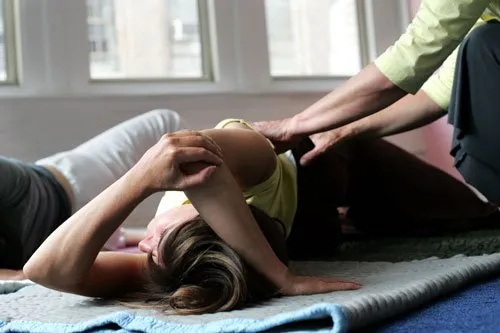
In a typical group lesson (30–90 minutes), students are guided through a sequence of slow, comfortable movements, always staying well within their individual capacities.
There is no stretching, straining, or forcing. Instead, the emphasis is on sensing differences, refining coordination, and allowing more efficient patterns of movement to emerge.
Lessons often build toward a more complex or integrated action—such as rolling to sit or turning with greater freedom—but the outcome is never the goal. What matters is the process of exploration.
Students commonly report:
- Reduced pain and tension
- Greater ease and fluidity in movement
- Improved posture and breathing
- A sense of calm, clarity, and presence
Beyond the Lesson
Feldenkrais is not only about moving better—it is about learning how we learn.
As students begin to recognize and release unnecessary effort in movement, they often notice similar patterns in other areas of life. The same qualities cultivated in a lesson—attention, patience, curiosity—can begin to inform how we meet challenges more broadly.
Over time, this can lead to a way of moving and living that feels more responsive, more efficient, and more aligned with a sense of ease.